Measuring What Actually Matters
How to separate useful growth signals from impressive-looking noise.
Metrics are not decisions
Numbers describe what happened. Decisions change what happens next. A good metric makes the next step obvious—not just interesting.
That distinction matters because dashboards can create the feeling of control without improving the work. A chart deserves attention when it changes a priority, reveals a risk, or helps a team choose between real alternatives.
Start with the business question
Define the outcome you are trying to influence, then work backward. If a metric cannot connect to that outcome, it is probably noise.
The useful question is rarely “what can we measure?” It is “what decision are we trying to make?” A team choosing where to invest needs different evidence from a team diagnosing why qualified demand fell.
Separate leading and lagging signals
Lagging signals tell you what already happened. Revenue, pipeline, and retained customers confirm an outcome after the work has had time to compound. Leading signals help you act before it does.
Track both, but do not confuse their roles. Search visibility, qualified visits, task completion, and content engagement may show direction earlier, while business outcomes confirm whether that direction created value.
A practical measurement hierarchy
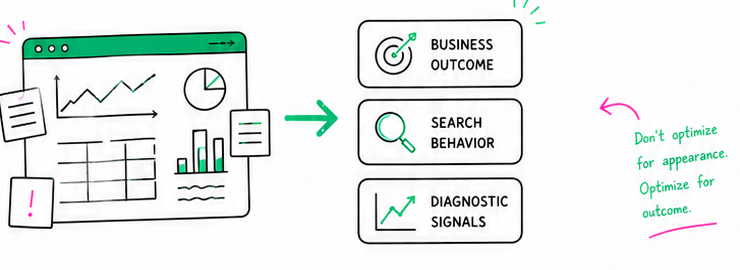
Put the business outcome at the top. It describes the impact you are trying to create and answers the “why.”
Under it, track search behavior: the queries, journeys, and actions that show how people express intent. This answers the “what.”
Use diagnostic signals at the base: indexing, rankings, click-through rate, page experience, and technical health. These indicators explain changes and answer “why now.” The hierarchy keeps local improvements connected to a real outcome.
Report movement, meaning, and action
Do not just show the change. Explain what it means and what you will do next. A report without a recommendation is only a recap.
For every important signal, describe the movement, the most credible explanation, the limits of the evidence, and the decision it supports. That makes reporting useful to people who do not live inside analytics tools.
Less noise, better decisions
The goal is not more data. It is better decisions. Fewer, clearer signals create more impact than crowded dashboards.
Remove metrics that never change a conversation. Give the remaining ones clear owners and review them on a cadence that matches the decision they support.
A useful metric changes a decision; everything else is context.